Goosey Goosey Gander
An Old Rhyme
A Read-Along Activity

The teddy bears were on a walk round their local wildlife pond, which they visited regularly. Suddenly, Bubbles, who was at the front of the group, suddenly stopped and pointed ahead.
"Ssssh! Look!" he called as quietly as he could.
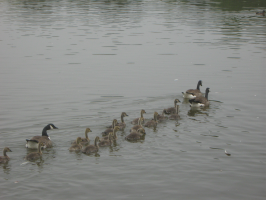
On the path in front of them were a pair of geese and a lot of tiny geese.
"How cute are they?" whispered Lizzie. "Are they little babies?" she asked.
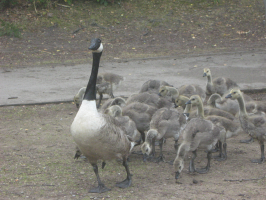
"Yes, they are," said Scary. "Actually, baby geese are called goslings. The word goose comes from the Old Norse word gás which later became the English word goose. Goose generally refers to either a male or a female, but a male is also called a gander. I know a nursery rhyme about them if you'd like to hear it?"
"Ooooh, yes please!" said Boo, who loved rhymes and poems.
"Goosey, goosey, gander
Whither shall I wander?
Upstairs, downstairs
And in my lady's chamber;
There I met an old man
Who wouldn't say his prayers,
So I took him by his left leg
And threw him down the stairs."
"That sounds a bit violent," he added, "but it's just a silly old rhyme."
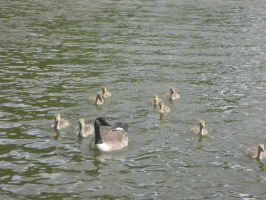
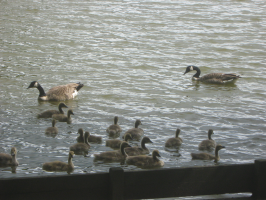
They all started to sing the words of the rhyme as they walked along, being very careful to leave lots of space between themselves and the goose family, as geese parents can be very cross if you get too close to their goslings.
"Tell us more about geese," pleaded Lizzie, who was very keen to learn, having fallen in love with the little characterful birds.
"Well, I don't know much more," replied Scary, "but I bet that Bubbles has brough his bird book with him and perhaps he will tell us some more interesting facts about geese from that."
Of course, when asked, Bubbles did have his bird book with him. He had loads of books about everything to do with nature and the outdoors but he had specifically chosen to bring his bird book to the wildlife pond so he could look up information about any birds they saw. He was delighted that the other bears were interested too.
He opened his book to the pages about geese.
"I think we've all seen geese flying high in the sky in a V formation," he began, "but do you know why?"
None of the bears had a clue.
"Well," began Bubbles, reading from his book, "the long distance flights that most migrations require can be hard on geese. This is why they fly in the V formation as it helps them to conserve energy.
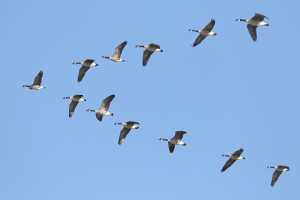
"But surely the bird in front gets very tired doing all that," interrupted Boo, feeling sorry for the lead bird.
"Yes, obviously the goose at the front gets tired much quicker than the rest of them, which is why they regularly switch places. And, geese regularly honk while they are flying so that they can remain in communication and encourage each other. That's especially helpful since they are very loyal birds and if one bird becomes sick or injured while they are flying in formation, then two other geese usually drop out to stay with it. Even though the rest of their group is continuing to fly away, these two geese will stay with the injured one to protect it until it recovers, and then all three will take off again in formation, maybe with another group, or attempt to catch up with their own group again."
"That's really nice," said Boo. "What kind birds they are."
As the bears walked along, they kept glancing back to see whether the geese were following them or not.
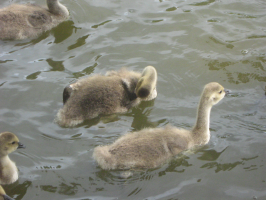
"It's a good job those goslings haven't just been born," continued Bubbles, "because they are impressionable little birds who, when they hatch, will follow just about anything that moves, from dogs to humans, mistaking the creatures for their mother. This is called 'imprinting'."
"They could have seen us first and thought they were little bears!" interrupted Boo, giggling. Everyone thought that would be very funny.
"But goslings use this skill to mimic the adult birds," continued Bubbles, "learning how to swim and what to eat just 24 hours after hatching. Their parents don't have to provide them with food - they know what to eat just by following what the adults eat, which is basically seeds, grasses, roots, grains, bulbs, berries and aquatic plants."
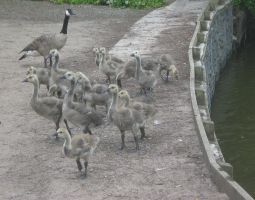
"They seem to be very clever birds," said Lizzie, "and very family-oriented - just like us bears!"
Everyone laughed, but agreed that geese were now one of their favourite birds. Perhaps when you next go out, especially to a pond or lake, you could look out for a goose, a gander and their goslings, and see what you think.